By Megan Dushin
In this article, Megan Dushin, MMCP in Minnesota, shares her experience working with a herd of mustang stallions (with one exceptional gelding). Becky Robb Hotzler, co-manager of the herd, invited Megan to visit the herd after seeing her work with a friend’s horse at a rescue facility, This Old Horse. This article was first published on Megan’s website at https://megandushin.com.
Word of Caution: Megan has a lifetime of experience working with horses, having grown up on a horse farm, and continuing her journey as a rider, riding instructor, teacher, and bodyworker. She took calculated risks entering the space of a herd of stallions with their primary caretaker, Robin. We do not recommend you take this same risk without proper training, support, and consideration.
Wow. What an experience.
I was recently invited to bring my skills as a horsewoman and bodyworker to a remarkable herd of mustang stallions—wild horses who once lived on the range—and who now live at a sanctuary.
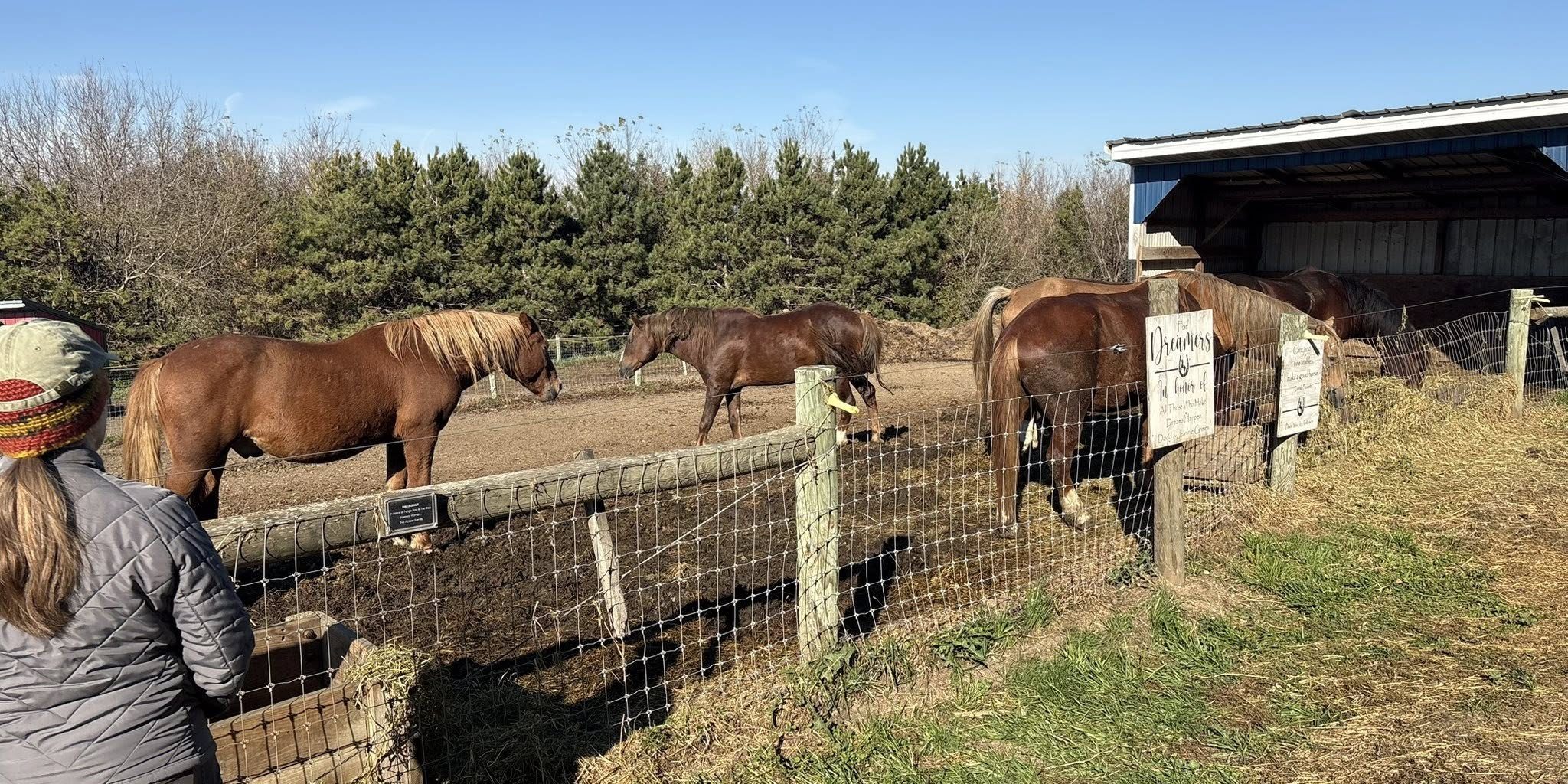
The Hallelujah Stallions at Wells Creek Wild Mustang Sanctuary are a group of special, older wild mustangs, many blind, rescued during the massive “Fleet of Angels” mission led by Elaine Nash, finding their permanent home at This Old Horse’s sanctuary in Goodhue, MN, where they live out their lives in peace, supported by donors and caregivers. They represent the last, most difficult-to place horses from that rescue, known for their unique Gila breed mix (a mix of Draft, Standardbred, Thoroughbred, and Morgan) and scars from the challenges of living in the wild. The herd now has hay, shelter, open space, and the care of devoted humans.
Preparing to Meet the Herd
Before visiting, I shared a few thoughts with the community about my approach:
“While Masterson Method® equine bodywork primarily involves hands-on techniques to release tension and improve wellness, this visit will be different. It’s my first time meeting the herd, and I’m curious about three things:
- How they interact with one another,
- How comfortable they feel in their own bodies, and
- How curious they are about us humans.”
I learned from Robin Dahling, co-manager of the herd, that two of the stallions had received some handling before. With those horses, I hoped to begin a gentle conversation—perhaps from a distance—using Horse Speak skills (inspired by Sharon Wilsie’s work). If a horse showed openness, I planned to explore touch or intention along the Bladder Meridian line, a foundational technique in the Masterson Method. You can learn more about this technique here.
First Impressions
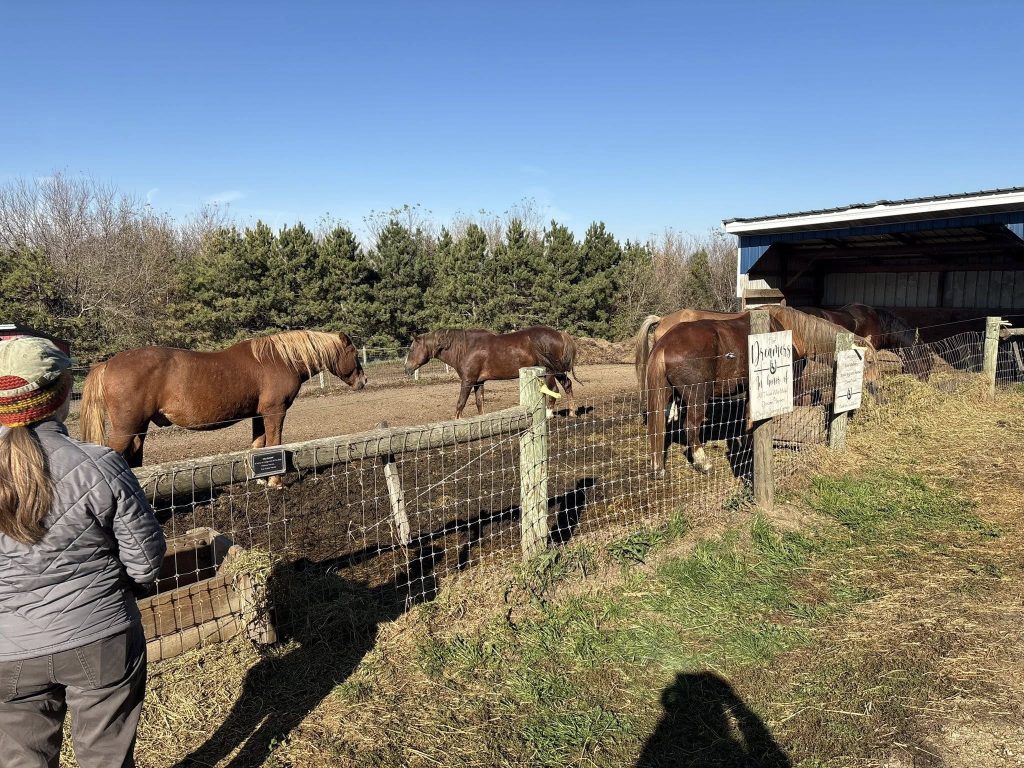
When I arrived, the herd stood together like a quiet symphony—eating, playing, drinking, moving—each gesture subtle and meaningful. No skirmishes. No noise. Just an unspoken understanding. Every horse knew their place, and every horse had a place. It was a testament to the sanctuary’s care and the deep peace within this herd.
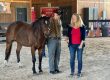
Robin, who tends to them daily, stood with me as we observed. I felt grounded beside her—she was their trusted human anchor. We had arrived shortly after hay was laid out, so the stallions were content, absorbed in their morning rhythm.
Meeting Warrior
Eventually, Robin pointed out Warrior—a blind stallion taking a break from eating. He was one of the more “touchable” members of the herd.
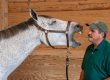
As I approached, Warrior neither shied away nor leaned in. He simply was. I offered a quiet greeting through my outstretched hand, but he declined. Interesting, I thought.
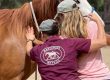
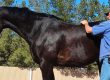
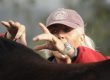
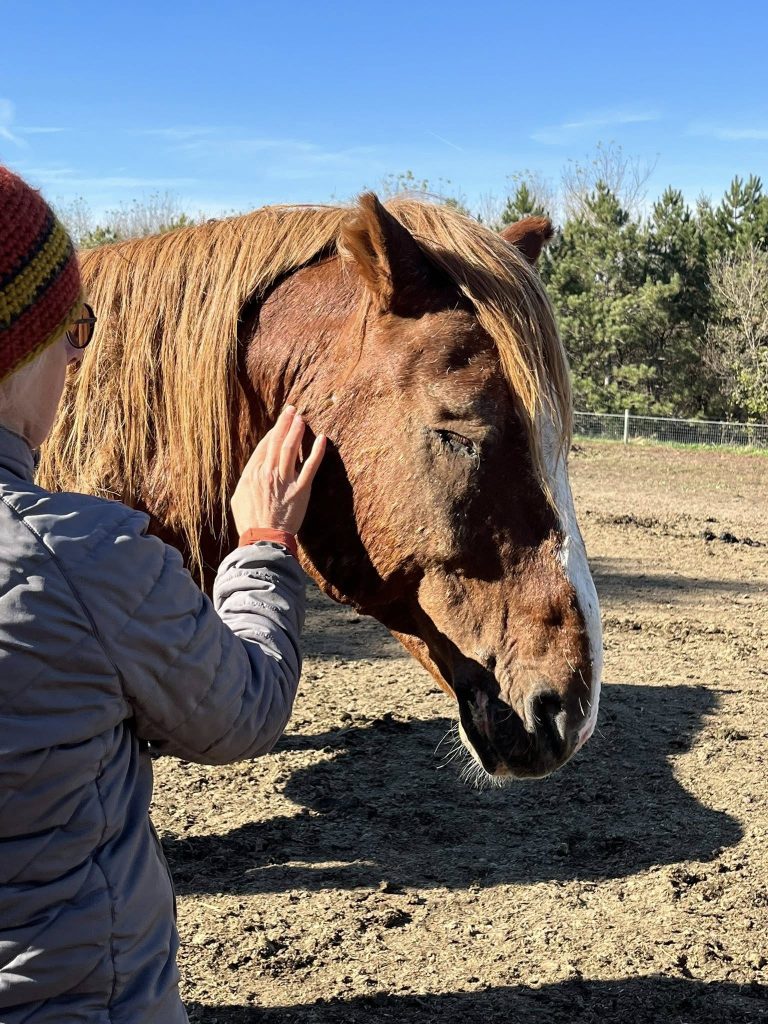
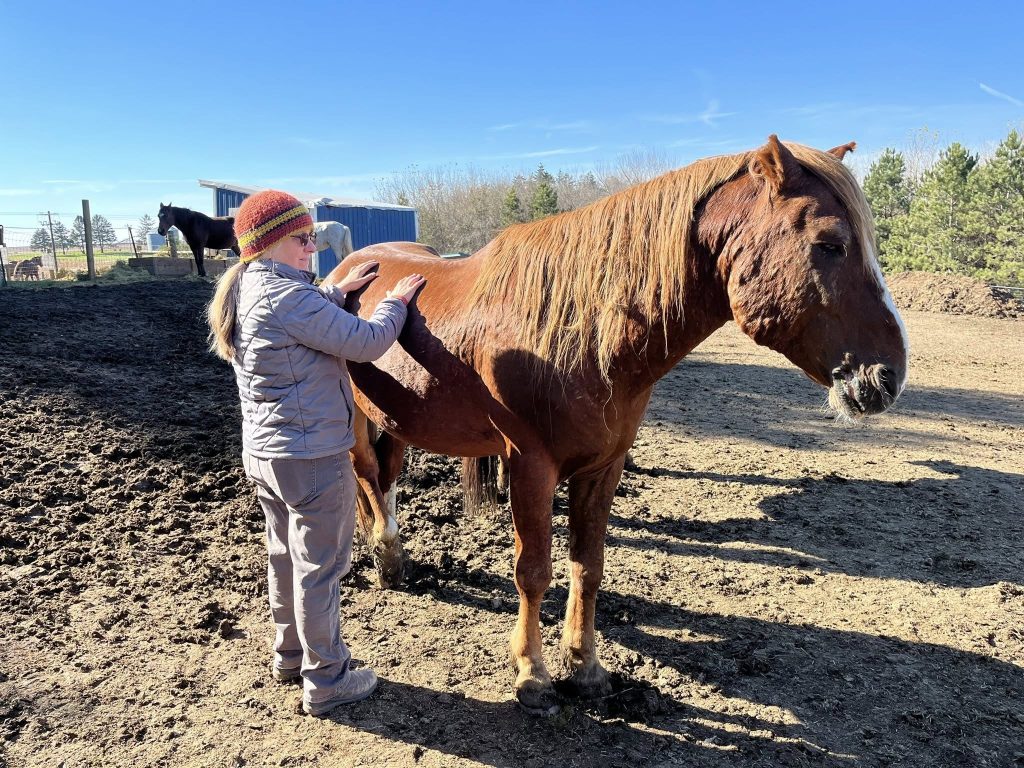
So I shifted—slowed down, softened my presence—and began to use light-touch Masterson Method techniques. In the photo below, you see me doing the Jawline Groove Technique. I also explored his temporomandibular joint or TMJ with this “search for a response, stay for a release” or SRSR light touch. Helping to awaken his topline and bring him into his body, I did some Crest Wiggle Technique, which is a subtle movement technique gently wiggling the crest from side to side. These techniques are taught in the Light to the Core video and course.
Within minutes, he subtly moved closer. Though Warrior cannot see, there was a moment when I noticed his sunken eye, with a small glint of brown, turn toward me. His awareness met mine. His quiet presence reminded me of an elephant—gentle, wise, and powerful.
We were having a conversation now, without words.
The Language of Release
As we worked, Warrior began to show small but powerful signs of release: a twitch, a resting hind leg, a lick and chew, a soft curling of the upper lip. These are the horse’s way of saying, I feel that. I’m processing. I’m letting go.
In a session, I try to remember to pause—sometimes stepping back completely to give the horse space. That pause is intentional. It’s the rest note in the music of bodywork. Without it, the song would be monotone. The pause is what tells the horse, I hear you. I’m listening. It transforms the moment into a two-way conversation.
The Sway
Every horse teaches something new. From Warrior, I learned to listen to what I now call the Sway.
Sometimes, during deep relaxation, horses begin a subtle rhythmic motion—side to side, like a tide. It feels connected to both breath and the craniosacral rhythms that move through all living beings. Warrior’s sway was steady and pronounced. I followed it, attuned myself to it, and later brought that sensitivity into a session with a domestic horse. The results were profound.
Being Seen in a New Way
What stayed with me most was how the herd didn’t interact. They didn’t seek touch or human validation. Many of them are blind, and it felt as though they “see” with their entire presence.
We as humans need to touch horses, feel regarded by them, be seen. This herd operates differently. Perhaps in large part because many of them are blind. They seem to “see” with their whole body, and not just their eyes and ears.
Often, after a day of equine bodywork, the horses come to mind, over and over as I drift off to sleep. Last night was one of those nights, though what was calling to me was the collective energy of the herd, and not one individual horse. This is what echoed into the evening: being seen by their whole bodies without even knowing I was being seen.
That kind of seeing—body to body, energy to energy—is the same kind of listening I strive for in my work with both horses and humans. It’s a conversation beneath words. A remembering of how to connect through stillness.
Resources
If you have a rescue facility and are looking for things you can do to enhance the health and wellbeing of your herd, I recommend the Light to the Core Video and/or the Light to the Core Course.
If you’d like to learn more about the herd, visit Hallelujah Stallions of the Wells Creek Wild Mustang Sanctuary, or request to join the group at Hallelujah Stallions on Facebook.
Megan Dushin, MMCP has a thriving equine bodywork practice with a variety of clientele, from performance sport horses, to rescue horses, to leisure trail horses. She certified as a Masterson Method® equine practitioner in 2018, and also serves as Mentor, Coach, and Instructor.